Why I wrote
American PTSD
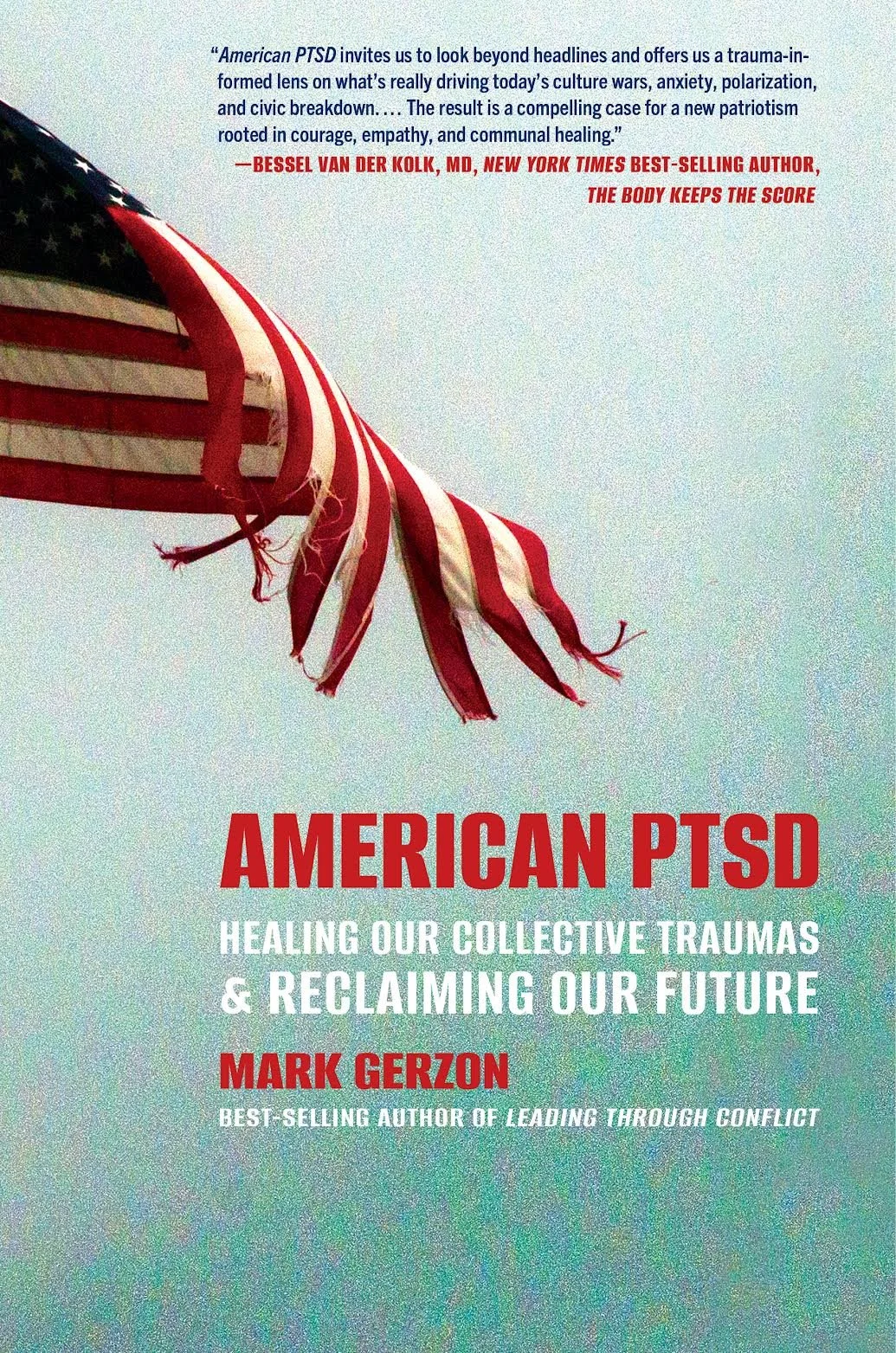
“I appreciate your interest in this book and becoming more trauma-aware. Perhaps you have already been on this healing journey alone, or with a counselor or therapist. But your intuition is right: there is another part of this journey that is not just about your psychology. It’s about our collective trauma, the unhealed wounds that are shaping the culture in which we live and why the American Disorder is undermining the American Dream. If you feel America is stuck in a loop, and you don’t want to be trapped in it, this book is for you. Through researching and writing this book, I have found that “American PTSD” is a useful lens for guiding us on this journey. The term is not a psychological diagnosis of any single person. It is a description of a cultural disorder. The phrase is a summary of what is wrong today with how we are living — politically, economically, and psychologically. It lets us see the road ahead, not only as separate personalities but as empowered citizens working together.”
-Mark Gerzon
How does this apply to you?
Six Traumas
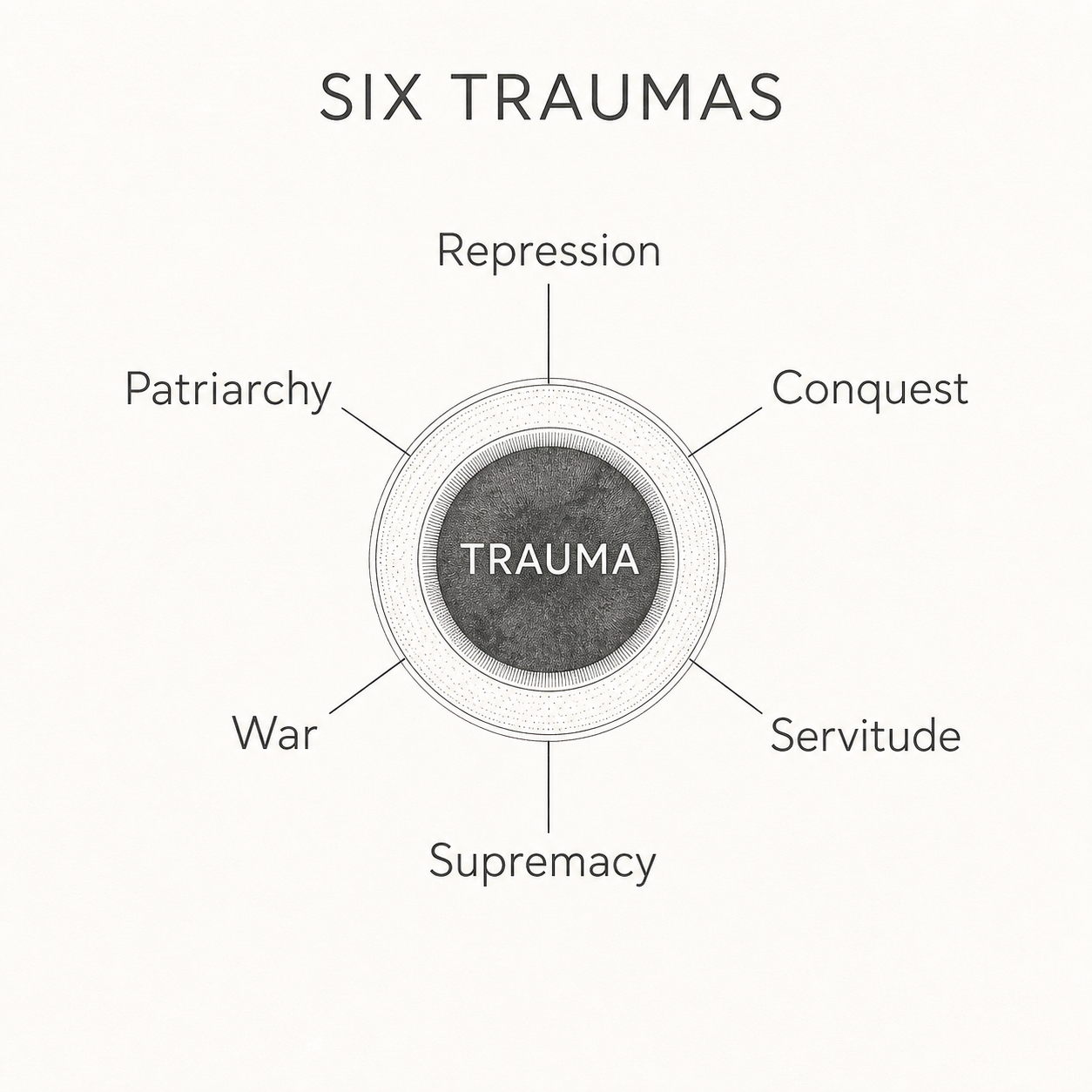
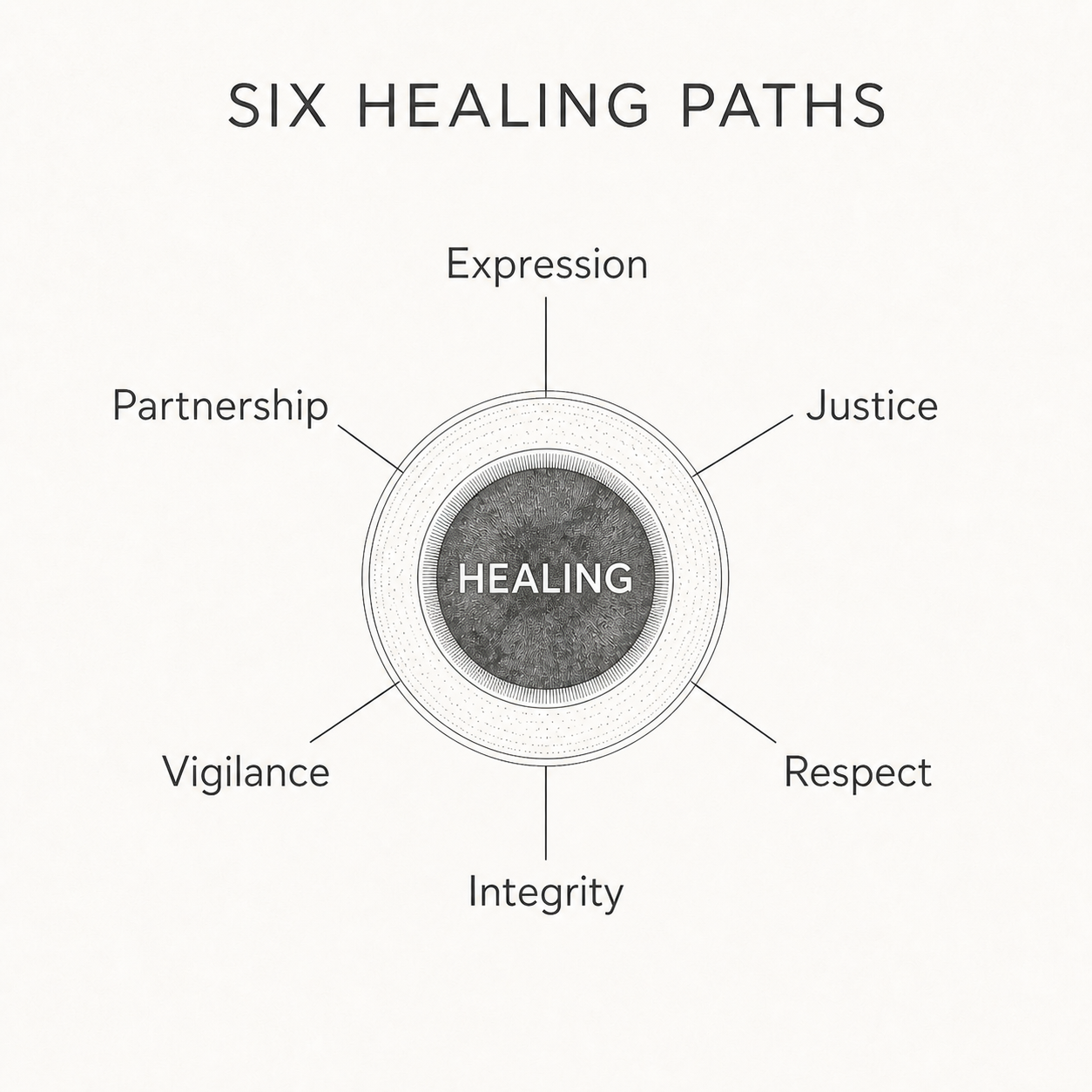
At the end of each chapter, there are reflection questions inviting readers to explore their own relationships to the 6 traumas and corresponding healing paths Mark outlines. Below you will find brief excerpts from those sections of the book.
-
When someone speaks about Americans living on “stolen land,” how do you react?
Do we know the history of the land where we live? If we own property, paid for with our hard-earned dollars, does the phrase “stolen land” irritate you? Do we feel people who bring up the subject, like Billie Eilish at the Grammys, are courageous . . . or hypocritical?
How does the furor over statues and monuments affect each of us?
When statues of the “heroes” who made our country possible are torn down, why do some of us feel pride, others sorrow and guilt, and still others anger? How do we feel about those who react differently than we do? Why do you think we seem to be at war about our own past?
As a community, what is “right relationship” with the land and those who came before us?
What are the histories of our hometowns? Have we benefited or been harmed—or both—by those histories? Does our own community need to reflect on our own history, and if so, why? How would we and our neighbors come together to answer that question?
-
Do not disrespect people just because you disagree politically.
Respect should not be limited to people who think like us. It is a basic human decency that crosses political dividing lines and includes every law-abiding citizen. This applies to each of us and, most of all, to our government. If we want to prune our bloated and inefficient federal government, for example, it should be trimmed surgically, not with a hatchet. It should be trimmed everywhere, not “Democrat” agencies.
It should be implemented in every state, not just ones that are “blue.” And it should be done out of vision, not retribution.
-
Seek out a wide range of wise mentors.
Few of us have been raised in a way that is integral, not partisan. Even fewer of us have unlearned the trauma-based racism that saturates our culture. Fortunately, we can re)educate ourselves by learning from the diverse and wise mentors who have emerged in our midst.
If we are readers, we can pick up Joy DeGruy’s Post Traumatic Slave Syndrome or Robin DiAngelo’s White Fragility or Laura Gomez’s Inventing Latinos. If we would rather listen to podcasts, we can listen to Code Switch or Diversity Gap or many other mind expanding options.
And if we prefer person-to-person learning, we can expand our circles of friends and colleagues to include folks different from ourselves and talk to them about their lives—and ours.
Finally, we can follow the news—from different sources—and take notice. The inspiring, healing stories can help us identify organizations we might join or reveal where we might make a difference.
-
Clarify your threat inventory.
A perceived threat needs to be taken seriously, but not conclusively. To determine our vulnerability accurately, we first need to focus on our perception. Are we triggered? Are we accurately diagnosing the threat? Are we minimizing or exaggerating it? Is our reaction shared by others—and if so, by whom? If the threat is real, what is the appropriate response?
To live vigilantly, we need to know what makes us afraid. But most of us are not clear about which threats are real and high risk or exaggerated and low risk. Do some research and make a list of threats and take the time to learn more about them. Some may rise to the top and inspire you to take precautions. Others may fall away as you realize they pose no immediate threat. Either with a trusted family member or friend, cross-check your inventory. It is important not to let ours fears isolate us.
-
Neighbors: “Community” requires tolerance and humility.
Couples: “Peace” and “Democracy” begin at home, with both of you.
Men: Replace scoring with devotion.
Women: Only put your trust in men who deserve that precious gift.
In October 2025 more than two thousand people from seventeen countries participated in the Peace Begins at Home Summit. The message was clear: What we want to see emerge socially and politically in our societies begins with our intimate partner. Whatever our view of politics or gender may be, we need to focus not only on what happens publicly in our national capital, our places of worship, and our workplace. We need to attend to what happens in our homes.
-
Get involved in organizations that build trust and empower citizens.
Literally thousands of organizations are now working to heal the divides that grew out of and reinforce our social trauma. From Braver Angels to Search for Common Ground America, from the Building Civic Bridges Act to the campus-based network Bridge USA, from the National Civic League to the National Conference on Citizenship, scores of initiatives are transforming their local hyperpartisanship by reclaiming their right to leave behind partisan divides and partner together as neighbors.
If you are “right of center,” I encourage you to learn more about Stand Together, a powerful engine of change with funding originally from Charles Koch. If you are “left of center,” learn more about PolicyLink and its flagship program “Project All.”
If you are determined to be a bridge-builder, go to the project incubator that I founded forty years ago, Mediators Foundation. Working with several partner organization, the Foundation launched a bold initiative called Better Together America. Its goal is to turn participating states and cities into laboratories for innovative civic partnership.
Six Healing Paths
-
Decide what is in your pack.
To heal ourselves and our country depends on the wounds that require care. For each of us, what is that wound? And what medicine do we have to heal it? What trauma moves each of us to heal: Economic insecurity and poverty? Racial disparities and discrimination? Environmental destruction? Election reform or voting rights? No one can dictate how our legacy of conflict should move each of us or what injustice should touch our heart. Only the person in the mirror knows.
Clarify your mission and focus on it.
“When you see wrong or inequality or injustice, speak out,” said US Supreme Court Thurgood Marshall. “This is your democracy. Make it. Protect it. Pass it on.” Overwhelmed by the polycrisis of these times, we may try to carry what does not belong to us. If it is not your calling, why not put it down? Why not lighten the load for the road ahead? We are needed, not just today, but tomorrow and beyond. When you find the cause that most deeply calls you, then follow the wise counsel of elders: Carry your own pack.
-
Do not disrespect people just because you disagree politically.
Respect should not be limited to people who think like us. It is a basic human decency that crosses political dividing lines and includes every law-abiding citizen. This applies to each of us and, most of all, to our government. If we want to prune our bloated and inefficient federal government, for example, it should be trimmed surgically, not with a hatchet. It should be trimmed everywhere, not “Democrat” agencies.
It should be implemented in every state, not just ones that are “blue.” And it should be done out of vision, not retribution.
-
Seek out a wide range of wise mentors.
Few of us have been raised in a way that is integral, not partisan. Even fewer of us have unlearned the trauma-based racism that saturates our culture. Fortunately, we can re)educate ourselves by learning from the diverse and wise mentors who have emerged in our midst.
If we are readers, we can pick up Joy DeGruy’s Post Traumatic Slave Syndrome or Robin DiAngelo’s White Fragility or Laura Gomez’s Inventing Latinos. If we would rather listen to podcasts, we can listen to Code Switch or Diversity Gap or many other mind expanding options.
And if we prefer person-to-person learning, we can expand our circles of friends and colleagues to include folks different from ourselves and talk to them about their lives—and ours.
Finally, we can follow the news—from different sources—and take notice. The inspiring, healing stories can help us identify organizations we might join or reveal where we might make a difference.
-
Clarify your threat inventory.
A perceived threat needs to be taken seriously, but not conclusively. To determine our vulnerability accurately, we first need to focus on our perception. Are we triggered? Are we accurately diagnosing the threat? Are we minimizing or exaggerating it? Is our reaction shared by others—and if so, by whom? If the threat is real, what is the appropriate response?
To live vigilantly, we need to know what makes us afraid. But most of us are not clear about which threats are real and high risk or exaggerated and low risk. Do some research and make a list of threats and take the time to learn more about them. Some may rise to the top and inspire you to take precautions. Others may fall away as you realize they pose no immediate threat. Either with a trusted family member or friend, cross-check your inventory. It is important not to let ours fears isolate us.
-
Neighbors: “Community” requires tolerance and humility.
Couples: “Peace” and “Democracy” begin at home, with both of you.
Men: Replace scoring with devotion.
Women: Only put your trust in men who deserve that precious gift.
In October 2025 more than two thousand people from seventeen countries participated in the Peace Begins at Home Summit. The message was clear: What we want to see emerge socially and politically in our societies begins with our intimate partner. Whatever our view of politics or gender may be, we need to focus not only on what happens publicly in our national capital, our places of worship, and our workplace. We need to attend to what happens in our homes.
-
Get involved in organizations that build trust and empower citizens.
Literally thousands of organizations are now working to heal the divides that grew out of and reinforce our social trauma. From Braver Angels to Search for Common Ground America, from the Building Civic Bridges Act to the campus-based network Bridge USA, from the National Civic League to the National Conference on Citizenship, scores of initiatives are transforming their local hyperpartisanship by reclaiming their right to leave behind partisan divides and partner together as neighbors.
If you are “right of center,” I encourage you to learn more about Stand Together, a powerful engine of change with funding originally from Charles Koch. If you are “left of center,” learn more about PolicyLink and its flagship program “Project All.”
If you are determined to be a bridge-builder, go to the project incubator that I founded forty years ago, Mediators Foundation. Working with several partner organization, the Foundation launched a bold initiative called Better Together America. Its goal is to turn participating states and cities into laboratories for innovative civic partnership.